

Ashland is United (AiU) was thrilled to be approached by Steve Mitchell, Board of Ashland Farmers Market to celebrate India’s Independence Day. AiU’s mission has been to build and strengthen bridges and educate and expose new ideas to people. We organize events in Town that represent their mission for creating inclusivity and acceptance. One of our primary projects is titled Flag Project that celebrates flags and varied nations represented in Ashland. In collaborating with the Ashland High School, we realized there were people from twenty-eight countries that made Ashland their home. The Flag Project provides an opportunity to acknowledge the nations through talks, moderated conversations, film screenings, flag raising. We have celebrated Ukraine, Sri Lanka and Haiti in the past. And now we get an opportunity to celebrate India!
Our collaborators Hashi Khushi of Greater Boston (HKGB), focus on cultural and secular events that celebrate the rich, diverse and traditional art from the eastern state of West Bengal. The state is also the birthplace of Nobel laureate Rabindranath Tagore. Members of HKGB gather around seasonal holidays. Quality programming like plays, dance, music celebrates a sense of belonging characteristic of the Indian community.
As part of their mission, gatherings inspire members to immerse themselves in the region’s cultural richness while fostering meaningful relationships and shared values. They aim to enrich lives, nurture belonging, and advocate for the transformative power of art. AiU worked in tandem with HKGB to develop a programming that would represent the multiple art forms from the varied corners of India.
Rajashree Ghosh from AiU facilitated the event. Others present from AiU included Karen Waldstein, Tonya Yaskovich, Vicky Tirell and Susan Brostrup-Jensen.
Rajashree provided the history of India becoming an independent nation. Midnight on August 14–15, 1947, was a triumph and a landmark moment in the returning of dignity to the peoples of Asia following the colonial period. The movement was an inspiration for oppressed nations around the world. Shortly before the stroke of midnight on August 14, India’s first prime minister, Jawaharlal Nehru, made a famous speech entitled “A Tryst with Destiny”:
At the stroke of the midnight hour, when the world sleeps, India will awake to life and freedom. A moment comes, which comes but rarely in history, when we step out from the old to the new, when an age ends, and when the soul of a nation, long suppressed, finds utterance.
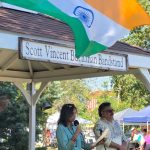
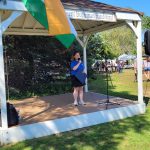
The Indian flag was raised at the bandstand. The tricolor flag has saffron, white and green bands. Saffron stands for strength, white for purity and the green for growth. A “chakra” or wheel is at the center of the white band and has twelve spokes. It was inspired by emperor Ashoka in the 3rd century BC and the spokes symbolize values such as justice, knowledge, love that guide the nation. Both anthems of India and US were played thereafter.
Select Board member Brandi Kinsman shared a few words in support of the event. She read out a citation that was received from Senate President Karen Spilka’s office. Ashland Town Manager Michael Herbert shared his heartfelt support of the Indian community. He mentioned how the Indian community in town accepted him with open arms. His words about AiU and our work in building community in our town has been most appreciated.
The morning began the youngest members of HKGB singing songs from Satyajit Ray’s films. Who is Satyajit Ray, you might ask? Martin Scorsese had said that Ray’s cinemas should be watched by “everyone with an interest in film”. Akira Kurosawa went further: “Not to have seen the cinema of Ray means existing in the world without seeing the sun or the moon.” So google him and watch his films. They were part and parcel of our lives.
Ashland resident Samik Sengupta read a poem written by Tagore in Bengali. Rajashree Ghosh followed after with its English translation. This poem is from ‘Gitanjali’ for which Tagore won the Nobel Prize for Literature in 1913. These lines speak across time and place as a deep yearning for freedom.
Where the mind is without fear and the head is held high
Where knowledge is free
Where the world has not been broken up into fragments
By narrow domestic walls
Where words come out from the depth of truth
Where tireless striving stretches its arms towards perfection
Where the clear stream of reason has not lost its way
Into the dreary desert sand of dead habit
Where the mind is led forward by thee
Into ever-widening thought and action
Into that heaven of freedom, my Father, let my country awake.
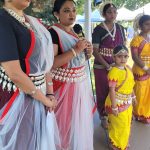
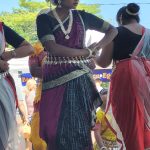
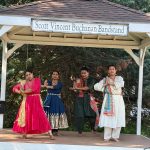
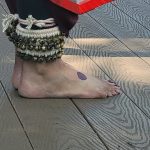
The next performance was titled Echoes of India represents the cultural mosaic. Three distinct forms of dance – Bharatnatyam –which began in the temples of South India; Kathak rooted in the courts of emperors in Northern India and a folk dance that is a spirited celebration of community and harvest from Bengal. These were foot thumping and the performers gave the attendees a demonstration of some of the intricate hand and feet movements.
Dancers from Upasana School of Dance performed Odissi – which a classical dance form from the state of Odisha in eastern India. It is recognized as one of the eight classical dance forms of India. The performers presented mythical and religious stories, devotional poems and spiritual ideas emoted through movements, expressions, impressive gestures.
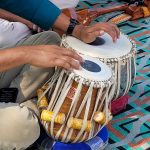
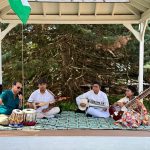
This was followed by a demonstration of Indian classical music instrument demonstration. Indian classical music is one of the oldest musical traditions of India. It is based on rāga (melodic framework) and tāla (rhythmic cycle), which together create both structure and space for improvisation. Performances often include singing, string instruments like the sitar, sarod, or veena, and percussion such as the tabla or mridangam.
HKGB members Sutapa Sengupta brought a team together with herself on the sitar, Anubhab Nandi on the sarod. Other performers were Dhiman Mondal, Sagar Dey and Arunima Joyoshree. The audience was rivetted by the presentation.
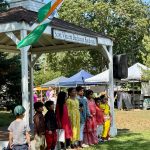
In conclusion, all present joined in to dance to the “bhangra” a truly spirited dance from the northern state of Punjab.
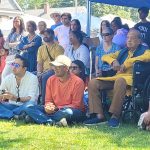
The event drew crowds from Ashland, neighboring towns and from people living as far as in Acton. Per an estimate there were about 2000 people attending the farmer’s market. As a successful event, this not only drew crowds, but also increased interest in the market, and learning about new forms of art – dance and music. More than anything it was a representation of community and celebration of strength in togetherness.


 Christa McAuliffe Center
  Henrich Communications
  MetroWest Medical Center